

# ChatGPT SEO Prompts: 40 Prompts by Task
ChatGPT SEO prompts are short text commands that turn a general chatbot into a working SEO assistant. This page gives you 40 of them, grouped by task: keyword research, search intent, content briefs, title tags, on-page SEO, technical SEO, local SEO, link building and reporting. Each prompt has placeholders in [brackets] for your own topic, plus one line on why it works.
Most lists stop at 5 prompts, 30 prompts, 35 prompts or 50 prompts, split into 6 categories, and leave you to guess which ones matter. These are copy-paste prompts sorted by the job in front of you, so you take the three you need today and come back for the rest. We also ran one of them through a real test, start to finish, shown below.
A lot of site owners start SEO on a tight budget. The realistic way to use ChatGPT is as a virtual assistant: it drafts meta tags, meta descriptions, title tags, keyword ideas and competitor research notes, while you bring SEO basics and the final judgment. Organic traffic still takes time. Early traction often shows after about 3 months, and the visibility, credibility and sales that matter usually build over a year of steady publishing. Where a prompt came from a known practitioner, such as Matt Diggity or Steve Toth, the pro tip says so.
For prompts built for other channels, browse the full ChatGPT prompts by channel hub.
Jump to: Workflow · Keyword research · Search intent · Content briefs · Titles and meta · On-page · Technical SEO · Local SEO · Link outreach · Reporting · FAQ
The 40 prompts at a glance
| SEO task | Prompts | Use them when you need to |
|---|---|---|
| Keyword research | 1-6 | Find seed terms, long-tails, questions, clusters and competitor gaps |
| Search intent and SERP features | 7-11 | Match the page type to intent and win snippets or People Also Ask |
| Content briefs and writing | 12-17 | Brief a writer, outline a post or refresh a page that slipped |
| Titles and meta descriptions | 18-19 | Write or fix title tags and meta descriptions for CTR |
| On-page optimization | 20-25 | Fix headers, internal links, semantic keywords, readability and alt text |
| Technical SEO audit | 26-31 | Audit robots.txt, sitemaps, canonicals, hreflang, speed and schema |
| Local SEO | 32-34 | Target city and "near me" searches and build local pages |
| Link outreach | 35-38 | Plan link-worthy content, PR angles and guest posts |
| Reporting | 39-40 | Diagnose traffic drops and mine Search Console data |
What are ChatGPT SEO prompts, and why use them?
AI SEO prompts are instructions that tell ChatGPT exactly what SEO output you want. A simple example: "Give me 15 high-intent long-tail keywords for a local bakery in Chicago." You get 15 keywords in seconds instead of an hour of manual work, which helps beginners and anyone without an agency budget.
AI is most useful for structure and repetition: keyword mapping, briefs, meta tags, heading structures and FAQs. It is least reliable for current data, first-hand expertise and E-E-A-T signals, which is why every prompt here leaves room for your own input.
Good SEO prompts for ChatGPT do three things well:
- Ideation and keyword clustering. ChatGPT is fast at keyword ideas, grouping terms and reading search intent, though it cannot replace dedicated tools for volume data.
- Structured content planning. It takes you from a keyword to a brief to a first draft, so every page starts with a plan. You still need SEO knowledge, because the strategy stays yours.
- Time and money. SEO usually takes 3-6 months to show results. Saving hours on content creation, keyword optimization and user engagement checks gives you a scalable workflow on a small team.
AI also adapts quickly to search changes. It can suggest titles shaped for featured snippets and People Also Ask, point out content gaps, apply SEO best practices for readability, and summarize how competitor websites structure their SEO strategies.
How to write SEO prompts that return usable output
The best AI prompts for SEO share one framework: Action + Target + Modifier + Format.
- Action: write, list, fix, audit, compare
- Target: title tag, blog post, homepage, product page
- Modifier: for B2C, under 60 characters, friendly tone, for Google
- Format: table, bullets, paragraph, JSON-LD, CSV
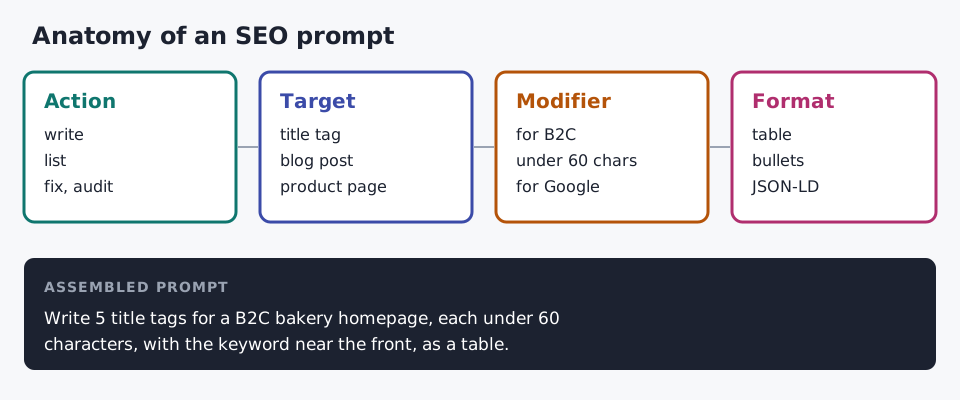
Before every task, tell ChatGPT the target page, your goal, the style and any word limits. The common mistakes that produce weak answers are easy to spot:
- Asking for a whole article in one prompt. You get a generic draft with no structure you chose.
- Leaving out the keyword or search intent. ChatGPT then guesses who the page is for.
- No topic or goal, or vague phrasing such as "make it better." Better for whom: readers, rankings or conversions?
- Publishing the output without a human review. Every fact, stat and claim needs checking first.
Three habits fix most problems. Give context about your site and audience. Feed real data from Search Console, your audit or your keyword tool instead of asking ChatGPT to guess. Name the output format you need. Write conversational prompts, the way you would brief a colleague, and save the ones that work in a prompt library in Notion, Google Sheets or Trello.
On models: older guides point to GPT-4o for complex work and GPT-4o mini for simpler tasks. As of October 2026, use the strongest reasoning option in your current ChatGPT model for multi-step SEO tasks, and a browsing-enabled model when a prompt needs live pages. For more worked examples, see our ChatGPT prompt examples and fill-in ChatGPT prompt templates.
We tested this: one real run, start to finish
Model: gpt-oss-120b · Date: 19 October 2026 · Run by: Clover Elise Winter
Input: Create a ChatGPT prompt for keyword research. Topic: chatgpt seo prompts. Audience: SEO beginners and small site owners. Output: a table of long-tail keywords grouped by search intent.
Raw output: a structured prompt with Role, Context, Task, Constraints and Output Format sections, asking for long-tail keywords in a five-column table grouped by search intent.
What we changed before using it: The tool's prompt was solid but open-ended. We set a fixed count of 30 keywords, named the market (United States, English), replaced the optional volume and difficulty columns with one labeled volume guess, excluded copywriting, social and email topics, and asked for a top-5 shortlist. On a second pass the tool replaced our topic with a placeholder, so we put the real keyword back before running it.
Result when run in gpt-oss-120b: Usable. It returned exactly 30 keywords (18 informational, 8 commercial investigation, 4 transactional), skipped navigational as instructed and labeled every volume figure as a guess. It still needed a human pass to merge overlapping keywords, drop awkward ones such as "best ChatGPT prompts for SEO tools" and validate every guess in a keyword tool.
A 7-step workflow for SEO prompting
Prompts work best in a fixed order. This is the workflow we use for every SEO page, and the prompts below slot into it.
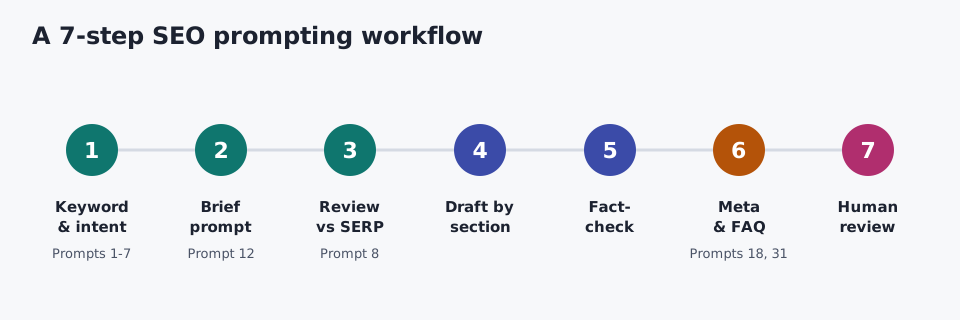
- Define the keyword, search intent and audience. Use Prompts 1-7.
- Build a brief prompt. Prompt 12 gives you the template.
- Generate the brief and review it against the live SERP. Prompt 8 keeps it grounded in what actually ranks.
- Draft one section at a time. Prompt each H2 separately and keep each answer under about 200 words.
- Fact-check everything. Stats, dates, product details and claims all need a source.
- Write the meta and FAQ copy. Use Prompts 18 and 31.
- Edit and run a human review. Add your voice, examples and first-hand detail before publishing.
ChatGPT prompts for keyword research
These ChatGPT SEO prompts are your ChatGPT prompts for SEO research. ChatGPT is strong at ideation and weak at numbers, so treat every search volume or keyword difficulty figure it gives as a guess, and validate it in Ahrefs, Semrush or another keyword tool. Our roundup of the best AI SEO tools covers options that do have real data.
Prompt 1: Seed keyword expansion
Give me 30 semantically related topics under the main category of [main topic]. Return a table with 5 columns: topic, seed term, search intent, funnel stage, content idea. Then pick the top 5 to focus on first and explain why.Why it works: the table forces structure and the top 5 follow-up turns a long list into a plan. Matt Diggity's version of this prompt, quoted in a 2024 expert-sourced prompt roundup, mapped seed keywords in the gym exercise niche.
Prompt 2: Long-tail keywords with buying intent
Using "[seed keyword]" as the seed term, list 15 long-tail keywords my customers might search when they are close to buying. Note the buying intent of each. Then name the 3 with the most commercial intent and explain why.Why it works: seed keywords are competitive, while 15 long-tail keywords around one theme (for example, sustainable fashion) give you pages you can actually rank.
Prompt 3: Question mining
List 25 question-based keywords people type into Google about "[topic]". Group them by funnel stage: awareness, consideration, decision. Add questions people commonly raise in Reddit threads on this topic.Why it works: questions map straight to FAQ blocks and People Also Ask, and the funnel split shows which ones belong on which page.
Prompt 4: Keyword clustering for a hub-and-spoke plan
Here are my keywords: [paste 20-40 keywords]. Group them into clusters that one page could cover. Name each cluster, choose a primary keyword for it, and lay out a hub-and-spoke plan showing which pages link to which. Suggest one blog topic per cluster.Why it works: keyword clustering stops two pages chasing the same query and builds topical authority one cluster at a time.
Prompt 5: Competitor keyword gap
My site is [your domain]. My competitors are [competitor 1] and [competitor 2]. Run a content gap analysis: list 20 keyword themes they likely rank for that I am missing, grouped by topic, with suggested content formats for each. Flag any themes where their page looks like thin content or relies on poor backlinks.Why it works: competitor keyword identification shows low-hanging opportunities. For live pages, use a browsing-enabled model or paste an export of their organic keywords and each competitor blog URL so the blog post ideas rest on real data.
Prompt 6: Missing and niche keywords
Here is my blog about [topic] and the keywords it targets: [paste list]. Which keywords are missing? Include trending keywords, keyword variations, zero-volume niche terms that still matter to buyers, and 15 high-performing keywords with low-competition long-tail options. Finish with an alphabet soup method list: one keyword idea for each letter A to Z.Why it works: it fills the competitor keyword gap from your own side, and the alphabet soup method surfaces odd phrasings tools often miss.
Search intent and SERP feature prompts
Search intent decides what kind of page can rank. These ChatGPT SEO prompts read intent first, then shape content for SERP features such as featured snippets, People Also Ask, voice search and image search.
Prompt 7: Search intent classifier
Classify each keyword by dominant search intent: informational, commercial, transactional or navigational. For each, write one sentence on what the searcher wants to see and recommend a page format (guide, product page, comparison, landing page). Keywords: [paste list].Why it works: a search intent classifier stops you writing a blog post for a keyword that wants a product page.
Prompt 8: SERP analysis from what you see
I searched "[keyword]" in an incognito window. The top 5 results are: [describe each in one line]. Tell me the dominant content format, the sections they share, the typical word count, and one angle none of them cover well.Why it works: SERP analysis grounded in the real results beats asking ChatGPT to imagine them.
Prompt 9: Featured snippet answer
Write a 40-50 word answer to "[question]" for a featured snippet. Then rewrite it as a step-by-step list of 5 steps or fewer.Why it works: short direct answers and step-by-step lists are the two snippet shapes Google pulls most often.
Prompt 10: PAA questions for an article
Which People Also Ask questions match my article about [topic]? For each H2 in this outline, write one sentence likely to trigger a PAA box, using structured answer formatting: answer first, detail second. Outline: [paste].Why it works: matching PAA questions to existing sections earns extra SERP space without new pages.
Prompt 11: Voice search and rich snippets
Reformat this paragraph for voice search: conversational question, one-sentence answer, then supporting detail. Then list ways to raise this page's chance of rich snippets, what visuals would help it in SERP, and what image data helps it appear in image search. Paragraph: [paste].Why it works: voice assistants read one clear answer, and visuals plus clean image data open a second route into the SERP.
AI prompts for SEO briefs and content writing
These cover ChatGPT prompts for SEO content writing, from AI prompts for content calendar planning to ChatGPT prompts for blogging. For persuasive copy, use our SEO copywriting frameworks and the copywriting prompts guide.
A brief writers can actually use names the keyword, search intent, audience, goal and the competing pages, then sets the heading hierarchy, the key questions to answer, a length range and an angle. Prompt 12 asks for all of it in one go.
Prompt 12: Full content brief
Create a content brief for an article targeting "[primary keyword]". Include target word count, search intent, a title under 60 characters, a meta description, a full H2/H3 outline with notes per section, 5 semantically related keywords, 3 internal links to these pages: [list], 2-3 authority sources to cite, and a unique hook competitors miss.Why it works: one content brief gives a writer everything, so the draft matches intent the first time.
Prompt 13: Detailed outline
Generate a detailed outline for a 1,500-word article about [topic]. Use headings and subheadings optimized for "[primary keyword]" and order them so each section answers the question the previous one raises.Why it works: an SEO outline with keyword-aware headings is the cheapest point to fix structure.
Prompt 14: Introduction and thesis statement
Write two introductions for a post on "[topic]" using the keyword "[keyword]", each under 120 words. Version 1 states what the article covers. Version 2 opens with the problem the reader has. Then suggest a thesis statement for the article.Why it works: two angles under 120 words let you pick a voice, and the thesis statement keeps the draft on track.
Prompt 15: Comparison brief (A vs B)
Write a brief for a "[product A] vs [product B]" comparison for buyers in the research stage. Include title, meta description, sections for features, pricing, pros and cons, use cases and a verdict, a comparison table layout, and 5 long-tail keywords this page should also rank for.Why it works: A vs B pages win commercial queries, and a fixed layout keeps the comparison fair.
Prompt 16: Pillar page and content calendar
Design a pillar page brief for "[broad topic]" targeting "[primary keyword]": a 2,500-4,000 word outline, a table of contents, and a list of [number] supporting articles (guides, a listicle, comparisons) with their target keywords. Then turn the supporting articles into a 12-week content calendar.Why it works: the pillar page and its calendar ship together, so spokes link back to the hub from day one.
Prompt 17: Content refresh brief
My article "[title]", published [date], dropped from position [old] to [current] for "[keyword]". Here is the text: [paste]. Act as a content gap filler: list missing sections compared with top-ranking pages, outdated stats to update, sections to expand and a better title if the current one underperforms. Rank changes by expected impact.Why it works: a content refresh brief fixes a page with dropped rankings and real history instead of starting over. After updating SEO content, change the published date and resubmit the URL in Search Console.
When you move from brief to draft, prompt the section copy one H2 at a time and keep each section under about 200 words. If you ask for a full 2,000-word post, give ChatGPT the outline, your brand voice and the top-ranking articles first, then treat the result as content expansion of your notes, not a finished piece. SEO blog writing still needs your stats, your expertise and a human touch, and every section needs an accuracy check before it goes live.
Title tag and meta description prompts
Title tags drive SERP click-through. Meta descriptions do not change rankings directly, but a better one lifts CTR, which helps indirectly. For bulk work, use the meta title generator and meta description generator.
Prompt 18: 5 title and meta pairs
Write 5 SEO-friendly titles for a page targeting "[target keyword]", each under 60 characters with the keyword near the front and a power word or number. Pair each with a meta description of 150-155 characters (always under 160 characters) that ends with a CTA.Why it works: 5 title and meta pairs give you real options to A/B test in Search Console after 30 days.
Prompt 19: Fix a low-CTR title
This page gets many impressions but a low CTR in Search Console. Current meta title (70-character): "[title]". Rewrite it in 3 variations under 60 characters. Keep "[keyword]" and make the benefit clearer.Why it works: it targets the title with proof of a problem. SEO practitioner Andrew Chornyy reported a CTR jump from 0.7% to 2.3% after a single title rewrite like this one.
Best AI prompts for SEO content optimization
Content optimization is where ChatGPT saves the most repetitive hours. These on-page SEO prompts cover header structure, internal linking, semantic keywords and readability.
Header structure
Prompt 20: Optimize headers
I am writing a [guide / landing page / product page] targeting "[primary keyword]". Suggest an H1 with the keyword, 6-10 H2s and H3s under each, using semantic variations in the subheadings. Make the page scannable. If I paste an existing outline, optimize headers instead of starting over: [paste].Why it works: header tags tell Google what each section covers, and matching H2s to featured snippet and People Also Ask topics wins extra placements.
Internal linking
Prompt 21: Internal link plan
Here is a new post about "[topic]" and a list of my existing articles: [paste titles and URLs]. Recommend 8-12 internal links with exact anchor text and where each should sit in the blog post. If the list is short, give me the 5 internal linking opportunities with the strongest topic match.Why it works: specific anchor text and placement turn a vague "add links" note into a 10-minute job.
Semantic keywords and NLP writing
Prompt 22: LSI and semantic keywords
My post on "[topic]" already uses the primary keyword "[keyword]". Suggest 10 LSI keywords and other semantic keywords to add naturally, and name the section where each fits. Do the same for this product description: [paste].Why it works: LSI keywords widen the page's topic coverage, and naming a placement stops them landing in one paragraph.
Prompt 23: NLP-friendly rewrite
Rewrite this section in an NLP-friendly way: clear subject, specific facts, one idea per sentence. Then check it for keyword stuffing and remove any repetition that reads unnaturally. Section: [paste].Why it works: Steve Toth covers this rewrite content approach in his SEO Notebook note on NLP-friendly writing with ChatGPT, and the stuffing check keeps NLP writing readable for people.
Readability and other on-page elements
Prompt 24: Readability and CTA review
Review this landing page: [paste]. Suggest an SEO-friendly URL structure, rewrite the intro paragraph to include the main keyword, flag sentences that hurt readability, and recommend CTA placement with one keyword-rich CTA.Why it works: it runs a quick content analysis across the elements most pages get wrong, and leaves you with well-written content to approve.
Prompt 25: Image alt text and file names
My page targets "[primary keyword]" and has [number] images showing: [describe each]. Write descriptive image alt text for each (under 125 characters, no stuffing) and suggest lowercase, hyphenated file names.Why it works: alt text helps screen readers and image search at once, and good file names cost nothing.
Technical SEO prompts for a site audit
ChatGPT will not crawl your site, but technical ChatGPT SEO prompts still help: it explains fixes clearly and writes the code. Paste real files and settings so it audits what exists.
Prompt 26: Robots.txt audit
My site runs on [WordPress / Shopify / custom] and has a blog, a store and a member-only section, so it serves mixed content types. Here is my robots.txt: [paste]. Flag important pages that are blocked and crawl waste that is not, then write an improved file with a comment on each rule.Why it works: a robots.txt audit catches accidental blocks before Googlebot does.
Prompt 27: XML sitemap strategy
My site has about [number] pages across these sections: [list]. My store has categories and subcategories. Design a sitemap strategy: what to include and exclude, whether to split into several sitemaps, and how to handle paginated URLs. Give me the sitemap index XML and how to add it in WordPress.Why it works: a split XML sitemap lets you track indexing per section in Search Console.
Prompt 28: Canonical tag audit
My site has these duplicate URL cases: [www vs non-www, trailing slashes, filtered category pages, tag archives]. For each, give the correct canonical tags in HTML, say where self-referencing canonicals apply, and list the common pitfalls that send Google mixed signals.Why it works: a canonical tag audit resolves duplicate URLs without deleting pages.
Prompt 29: Hreflang generator
My site has these language versions: [list URL patterns]. Write the hreflang link elements, including x-default, for the page at [path]. Check for missing return links and wrong language codes, and give the sitemap version too.Why it works: a hreflang generator prompt gets the codes right, which is where most hreflang setups fail.
Prompt 30: Page speed checklist
My page [URL] scores [score] on mobile. Flagged issues: [list]. My stack is [CMS]. Build a page speed checklist ordered by impact on LCP, CLS (target under 0.1) and INP, with effort level for each fix. Include image compression and mobile usability fixes.Why it works: ordering by Core Web Vitals impact stops you spending a day on a fix that moves nothing.
Prompt 31: FAQ copy and schema markup in JSON-LD
Write 5 FAQ answers for my page about "[topic]", each 2-3 sentences and answer-first. Then generate JSON-LD schema for this [article / FAQ / product / local business] page at [URL], by [author], published [date], including all required and recommended properties and FAQPage markup for those questions.Why it works: valid schema is tedious by hand and quick to check in Google's Rich Results Test, and short answer-first FAQs are what AI search tools quote. For an ecommerce SEO page, ask ChatGPT for product FAQs first, then use FAQ prompts like this one to add FAQ schema. Our Etsy SEO guide shows this on product pages.
Quick technical SEO prompts for smaller jobs: spot duplicate meta descriptions in a list of URLs, check content for missing heading levels, list the HTML tags that matter on product pages, plan a cleanup of broken links across 200+ posts, or build a 301 redirect map in CSV before a site migration.
Local SEO prompts
Local ChatGPT SEO prompts work best with your real city, services and neighborhoods in the brackets.
Prompt 32: Local keywords
I own a [business type] in [city, state]. Generate 20 local keywords: "[service] in [city]", "near me" phrases, neighborhood terms and local long-tails. For each, say whether it belongs on the homepage, a service page or a blog post.Why it works: deciding where each of your local keywords lives prevents two local pages competing.
Prompt 33: Google Business Profile posts
Write 4 Google Business Profile posts for my [business] in [city], one per week, each under 150 words, each built around one of these keywords: [list]. Add a clear action at the end of each.Why it works: regular posts keep your profile active for the map pack, and tying each to a keyword keeps them on topic.
Prompt 34: Service area page brief
Create a brief for a service area page for [service] in [area]. Include local proof points to gather (projects, reviews, landmarks), an H2/H3 outline, and LocalBusiness schema fields I need to fill in.Why it works: local proof is what separates a real service page from a city-name swap, and Google can tell the difference.
Link outreach prompts
Link building prompts here focus on what earns links. For outreach email templates and pitch email copy, use our email and outreach prompts. For turning LinkedIn posts into link bait, see the social media prompts.
Prompt 35: Link-worthy content ideas
I run a [business] in [industry] for [audience]. Suggest 10 link-bait topics other sites would want to cite. For each, give the format (original data, tool, guide), production effort, and 3 types of sites likely to link.Why it works: original data earns links almost on its own, including B2B backlinks that are hard to get any other way.
Prompt 36: Broken link prospecting
Give me 15 Google search queries to find resource pages in [niche] likely to have broken outbound links. For each, explain what page it finds and how to approach the owner.Why it works: broken link prospecting gives site owners a reason to reply: you are fixing their page.
Prompt 37: Digital PR story angles
My company is a [business] with access to [data or expertise]. Suggest 8 digital PR story angles, each with a journalist-style headline, the timely hook, the beats that would cover it, and a 2-sentence pitch. Add one short HARO pitch for an expert roundup in [topic].Why it works: story angles with a "why now" hook earn coverage, and coverage brings links from sites that rarely accept a guest post.
Prompt 38: Guest post topic pitches and brand mentions
I want guest posts on these sites: [list 3-5]. For each, suggest 3 topics they have not covered that let me link to [my page], with a one-paragraph pitch. Then list ways to find unlinked brand mentions of [brand] and ask for a link.Why it works: guest post topic pitches built around each site's gaps get accepted, and unlinked mentions are links already half earned.
Other quick link prompts: run a competitor backlink audit from an exported list, choose anchor text for homepage backlinks, or draft a customer testimonial for a tool you use that includes a link to your site. Link-worthy content still does the heavy lifting.
SEO reporting prompts
Feed these ChatGPT SEO prompts real numbers. Audit data from an SEO analyzer extension or Search Console turns vague advice into fixes for specific issues.
Prompt 39: Traffic drop diagnosis
My site [domain] lost [percentage]% of organic traffic starting [date]. Recent changes: [list]. Walk me through a traffic drop diagnosis in order of likelihood: algorithm updates, crawl or indexing errors, manual actions, content quality, lost backlinks, SERP changes, seasonality and tracking. For each, tell me what to check and which tool to use.Why it works: a fixed order stops panic edits, and most drops trace back to one of the first three causes.
Prompt 40: Search Console analysis
Here is my Search Console export for [page or site] over [period]: [paste]. Find queries with 1,000+ impressions and under 3% CTR, queries in positions 11-20, and pages competing for the same query. Give actions ordered by traffic impact.Why it works: high impressions with low CTR is the fastest win in SEO, because you only need to rewrite titles and descriptions.
The same approach covers a monthly SEO report template, content ROI scoring for old posts, and a GA4 exploration that tracks organic visitors to conversion. For competitor benchmarking, ask ChatGPT for a framework comparing traffic share, ranking tiers, domain rating, content output and SERP feature ownership, then fill it from your tools. Revisit your SEO strategy at least quarterly.
Where ChatGPT falls short for SEO
Knowing the limitations keeps your ChatGPT SEO prompts honest:
- No real-time data. It cannot crawl the web, show live search volume or track rankings.
- Late on algorithm updates. Its knowledge lags behind Google's changes.
- No backlink analytics. It cannot see who links to you.
- Generic strategy. It gives sound general SEO strategy advice, but a site-specific plan needs your data and judgment.
Treat AI prompts for SEO strategy as a sounding board, not the plan itself.
Can ChatGPT SEO prompts produce high-ranking articles? Yes, if you use them in the right order. B2B SaaS SEO consultant John Ozuysal, quoted in a 2024 expert-sourced prompt roundup, advises against publishing AI drafts. Write the article yourself or hire an expert, then use ChatGPT to extract entities, run on-page SEO checks, confirm search intent and find gaps against competitor content.
Start with 3 prompts
Pick 3 prompts: one for keywords, one for content and one technical fix. Test prompts on a single page this week and measure the result before you scale. Small SEO gains on one page show you which prompts belong in your workflow, and organic growth follows from repeating what works.
Ready to build your own? Our free Prompt Generator turns a keyword and goal into a structured prompt you can paste into ChatGPT. Generate an SEO prompt for your keyword →
More channels and prompt sets live in the ChatGPT prompts by channel hub. See also: How to Write Better ChatGPT Prompts.
Related tools: Paragraph rewriter · Grammar fixer · Meta title generator · Meta description generator
FAQ
What are the best ChatGPT prompts for SEO?
The best ChatGPT prompts for SEO, like the best ChatGPT SEO prompts on any list, are specific: they name the task, the page, the keyword and the output format. ChatGPT suits structured, repeatable SEO tasks best, such as keyword mapping, briefs, meta tags, heading structures and FAQs. The highest-value ones on this page are seed keyword expansion (Prompt 1), the search intent classifier (Prompt 7), the full content brief (Prompt 12) and Search Console analysis (Prompt 40). The best SEO prompts also include your own data.
Can ChatGPT do keyword research?
Partly. ChatGPT is good at ideation: it expands seed terms, finds questions and groups keywords. Its keyword estimates and volume estimates are directionally useful at best, because they come from language patterns, not real search data. It cannot replace SEO tools or automate SEO. Validate every list in a keyword tool such as Ahrefs or Semrush, and keep human oversight on accuracy, planning and strategy. Use ChatGPT for the research, and tools for the numbers.
How do I turn a keyword list into prompts?
Paste the list into Prompt 4 to cluster it, then run Prompt 7 on each cluster to set intent, then Prompt 12 to build a brief per cluster. Give context (site, audience, goal), real data and a format each time. Those three things decide the quality of your results more than wording does.
Are AI-written SEO articles safe for Google?
Google says it does not penalize AI content for being AI content. It does penalize low-quality content however it was made. ChatGPT can draft an SEO article, but drafts published without review rarely rank. Articles are safe when they show real expertise, use verified data and sit inside a topic you cover in depth. Our guide to topical authority explains how to build that coverage.
Which prompts work for local SEO and technical SEO?
For local SEO, start with Prompts 32-34: local keywords, Google Business Profile posts and service area pages. For technical SEO, use Prompts 26-31 for robots.txt, sitemaps, canonicals, hreflang, page speed and schema, and paste real files so ChatGPT audits what exists rather than guessing.