Best Practice
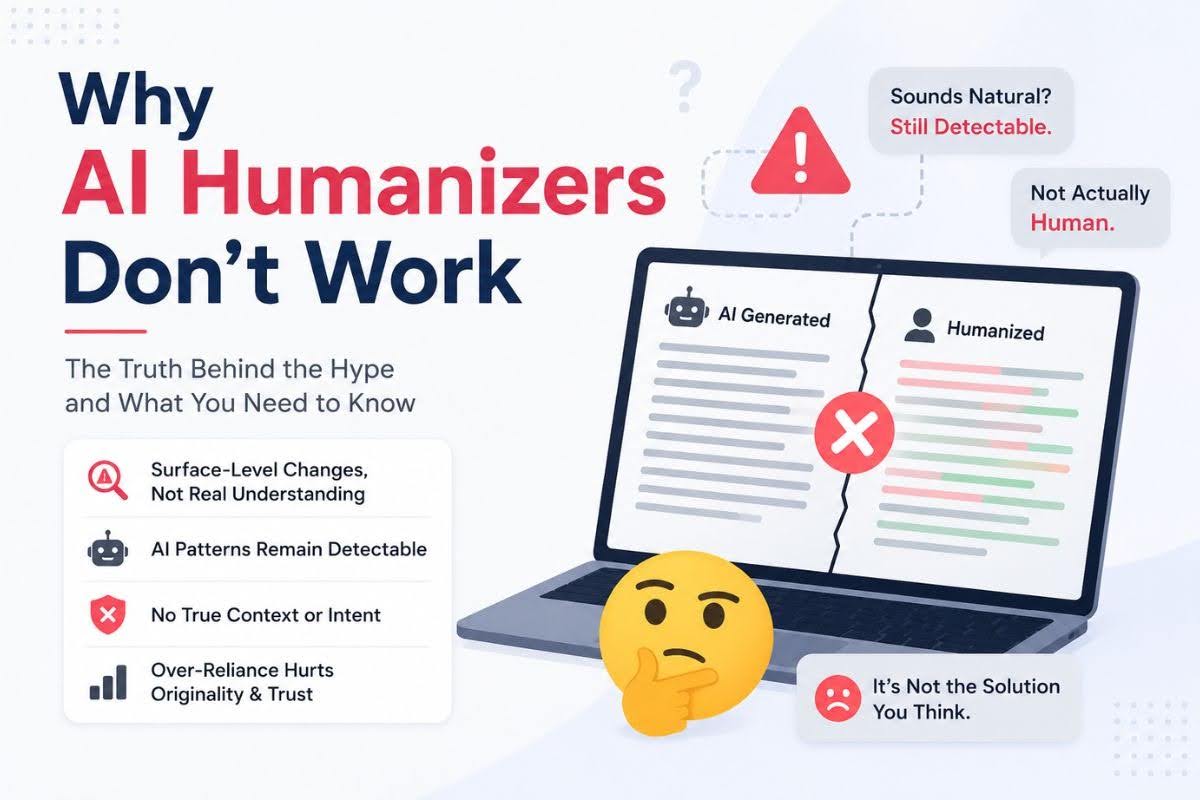
Why AI Humanizers Don’t Always Work (And What Does): An Honest 2026 Guide
 By Muhammad AdnanPublished
 An honest look at why AI humanizers fall short of their promises — the detection arms race, meaning drift, and the limits of rewriting — plus what actually produces writing readers trust.
The promise versus the reality
Most humanizer landing pages make two promises: your text will read as perfectly human, and it will be undetectable by AI checkers. Both promises are tempting, and both are where expectations quietly come apart. Plenty of writers paste a draft, run it through a tool, and are surprised when a detector still flags it or a reader still senses something off.
This guide explains why AI humanizers don’t always live up to the pitch — not to dismiss them, but so you know what you are actually buying. Understanding the limits is what lets you use these tools well instead of trusting them blindly, and it points to the approach that does hold up.
Where these tools genuinely fall short
The gap between the marketing and the result comes down to a few concrete limitations, none of which a single rewrite can fix:
- The detection arms race never stops. Detectors retrain constantly, and rewriters chase them. A trick that bypasses a checker this month can be caught next month, so no tool can honestly guarantee "undetectable" as a permanent state.
- Detectors disagree with each other. The same paragraph routinely gets different verdicts across different checkers. When the scorers themselves do not agree, optimizing to beat one of them is a moving, unreliable target.
- Rewriting does not add understanding. A humanizer predicts smoother wording from patterns; it has no real-world experience, opinion, or memory of your specific situation. It cannot supply the concrete example or point of view that makes writing feel genuinely human.
- Aggressive rewrites cause meaning drift. Pushing hard for "natural" phrasing can change a number, soften a claim, or flip the point of a sentence — trading a robotic-but-correct draft for a smooth-but-wrong one.
In short, the tools are good at surface fluency and weak at everything underneath it. That is also why we are careful, in our deeper look at whether humanizing AI text actually works, to frame it as a drafting aid rather than a guarantee.
Myth versus reality
It helps to put the common claims next to what tends to happen in practice:
| The claim | What actually happens |
|---|---|
| "100% undetectable" | Detectors change and disagree; no permanent bypass exists |
| "Sounds fully human" | Reads smoother, but still lacks specific detail and real perspective |
| "One click, done" | Best results need a human read and a meaning check afterward |
| "Works for any text" | Risky for quotes, stats, and technical lines where exact wording matters |
| "Replaces editing" | Replaces the easy part; the judgment part is still yours |
None of this means the tools are worthless. It means the honest version of their value is narrower — and more durable — than the headline promise.
What actually works instead
The approach that survives every detector update is the unglamorous one: write something genuinely worth reading, and let the rewriting tools handle mechanics rather than miracles. In practice that means:
- Fix the substance first. A draft that is specific, accurate, and has a clear point reads human because it is human in the ways that count.
- Use a humanizer for the mechanical layer — sentence variety, rhythm, trimming hollow filler — not as a detector-bypass button.
- Add what no model can: a real example, a number from your own work, an opinion. This is the single biggest difference between "smoothed AI text" and writing readers trust.
- Compare the rewrite to your original every time, so polish never quietly costs you accuracy.
If you want to know what you are actually correcting for, our breakdown of why AI writing sounds robotic names the specific patterns — uniform sentence length, vague generalities, hollow transitions — that signal "machine" to both readers and detectors.
Using the tools the right way
Within those limits, the tools are genuinely useful. We built the AI Humanizer to do the honest job well — vary rhythm, cut robotic phrasing, preserve your meaning — and we do not promise it will beat every detector, because nothing can. Pair it with the Natural Tone Rewriter when a passage needs to fit a specific audience.
Treat the AI Detector the same way: as a diagnostic, not a scoreboard. A high "AI" score is a hint that a section is generic or patterned, which tells you where to add specificity — chasing the number itself is the trap this whole guide is warning about. For the step-by-step version, see how to humanize AI text.
The bottom line
AI humanizers do not work the way their landing pages imply — there is no permanent cloak of invisibility and no substitute for having something to say. What they do well is remove the mechanical tells of AI prose so your real thinking comes through. Use them for that, keep a human in the loop, and you stop fighting detectors and start writing things people actually want to read.
FAQ
The two headline promises — fully undetectable and perfectly human — both break down in practice. Detectors retrain constantly and disagree with each other, so no bypass is permanent, and rewriting smooths wording without adding the real understanding, specifics, or perspective that make writing genuinely human.
No tool can guarantee it. Detection and rewriting are locked in a constant back-and-forth, and the same text often scores differently across checkers. Optimizing for a permanent bypass is chasing a moving target; writing for real quality is far more reliable.
Not at all — their honest value is just narrower than the marketing. They are good at the mechanical layer: varying sentence rhythm, cutting robotic filler, and improving readability. They are not a substitute for accurate content, a clear point, or human editing.
Fix the substance first, then use the tool for mechanics. Make the draft specific and accurate, add a real example or number only you can provide, run a humanizer for rhythm and flow, and compare the result to your original to protect the meaning.
As a diagnostic, not a scoreboard. A high score usually flags a section that is generic or patterned, pointing you to where more specificity is needed. Use it to find weak spots, not to chase a number.
Try the related tool
Transform AI-generated text into natural, human-sounding writing. Eliminate robotic patterns, vary sentence rhythm, add specificity, and produce content that reads like an experienced human writer.
Open AI HumanizerSupporting pages
Related articles
Does humanizing AI text actually work? It depends on the draft, the tool, and your review. Here is an honest look at what AI humanization does well and where it falls short.
Read articleAI writing sounds robotic because of identifiable patterns: uniform sentence length, predictable transitions, low specificity, and generic phrasing. Here is what each pattern looks like and how to fix it.
Read articleA quality-focused guide to improving AI-assisted drafts without detector-bypass claims or shallow paraphrasing.
Read article