
Best Practice
Russian Humanoid AI Robots: Innovations, Applications, and Future Developments
 By Muhammad AdnanPublished
 A clear overview of Russian humanoid AI robots: the technology behind them, key innovations, real-world applications, benefits, challenges, and what comes next.
Introduction
Robotics and artificial intelligence are changing industries around the world. One exciting area of development is the Russian Humanoid AI Robot, which combines advanced engineering with intelligent software. These robots are designed to perform tasks, interact with people, and assist in different environments. Many projects focus on creating a human-like machine that can work efficiently while adapting to changing situations. The same wave of AI also powers everyday writing tools, such as our AI Paragraph Rewriter for quick, clean edits.
As the technology evolves, these robots have become an important part of modern research. Scientists and engineers are refining robot movement, communication, and decision-making to make them more capable and reliable.
What Is a Russian Humanoid AI Robot?
A Russian Humanoid AI Robot is a robot designed to resemble human behavior and movement. These machines often include artificial intelligence, sensors, cameras, and advanced software that allow them to interact with their surroundings.
Many are developed as research prototypes, helping engineers test new technologies before large-scale production. They often form part of a wider robotics innovation program focused on advancing what machines can do.
The Technology Behind Russian Humanoid AI Robots
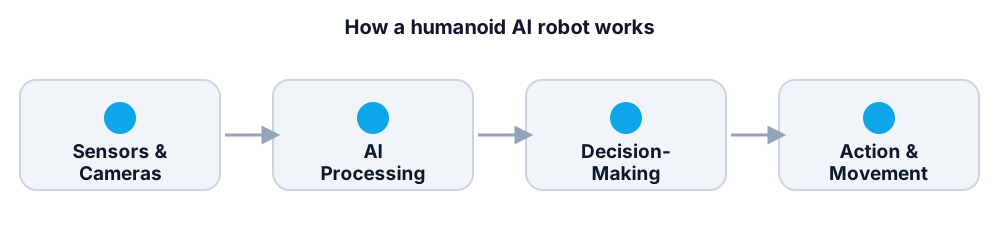
The success of these robots depends on advanced hardware and software working together. They use sensors to detect objects, cameras to recognize people, and AI algorithms to process what they observe.
A well-designed robotics system lets a robot move more naturally and perform complex tasks, while autonomous decision-making helps it act without constant human control.
Key Technological Innovations
Human-Like Movement
One major innovation is natural movement. Engineers work to make robots walk, balance, and perform actions much like people do. Better motion control helps them navigate different environments, which improves how these machines perform in real-world situations.
Advanced Communication
Communication is another important innovation. These robots can process speech, recognize commands, and respond. Many begin as prototypes before being integrated into commercial applications, and their communication features help them interact with people in a more natural way.
Independent Decision-Making
Modern robots are becoming smarter and more independent. A robot can analyze information and make decisions based on its programming, performing tasks with minimal supervision. This increases efficiency and expands the potential use cases.
Real-World Applications
Industrial Operations
Many industries are exploring these robots to improve productivity and safety. A capable robotics system can perform repetitive tasks, reduce human workload, and operate in environments that may be dangerous for workers.
Healthcare Assistance
Healthcare is another area where these robots can provide value. They may assist medical staff by delivering supplies, supporting patients, and handling routine activities — improving service efficiency while helping healthcare professionals focus on critical responsibilities.
Education and Research
Educational institutions often use these robots as a learning and research tool. Many universities run robotics programs to study artificial intelligence, engineering, and automation, helping prepare future generations of engineers and scientists.
Customer Service
Customer-service settings are benefiting too. Robots can provide information, answer common questions, and assist visitors, delivering consistent support while improving the overall experience.
Practical Benefits
Increased Efficiency
One of the biggest benefits is improved efficiency. Robots can work continuously without fatigue and complete tasks quickly, handling routine activities so human workers can focus on more complex responsibilities.
Enhanced Safety
These robots can perform tasks in hazardous environments where human safety may be at risk. They can enter dangerous areas and complete operations while reducing the risks for people.
Continuous Learning
Many robotic systems are designed to improve over time. Using machine learning, a robot can learn from data and experience to enhance its performance and adapt to changing conditions.
Current Challenges
Despite rapid progress, the field still faces real challenges. Building robots that move naturally and make accurate decisions requires significant research and investment. Platforms like TextToolsAI help researchers and content creators explain these complex developments in a simple and clear way for wider audiences.
Bringing one of these robots to market often involves years of development and testing before it becomes commercially available. Cost, complexity, and technical limitations remain important factors that slow down progress in this field. With tools like a paragraph rewriter, such technical topics can be simplified for better understanding and communication.
Another challenge involves improving how these machines communicate. Researchers continue working to make human-robot interactions more natural and effective, and an article summarizer can help present these advancements in a more readable and structured format for education and awareness.
Future Developments
The future of the Russian Humanoid AI Robot looks promising. Advances in artificial intelligence, robotics hardware, and software development are creating new possibilities. TextToolsAI can help explain these future trends in simple language so more people can understand how robotics is evolving.
Future versions may include more sophisticated automation that enables better mobility and stronger problem-solving. More capable autonomous systems may also let robots perform increasingly complex tasks with higher accuracy and independence.
As research continues, many experts expect the Russian Humanoid AI Robot to play a larger role in business, healthcare, education, and everyday life. With the support of TextToolsAI, information about these advancements can be shared more clearly, helping users stay informed about the future of robotics.
Conclusion
The Russian Humanoid AI Robot represents an exciting step forward in robotics and artificial intelligence. These machines combine intelligent software, advanced sensors, and human-like movement to perform a wide range of tasks. From healthcare and education to industrial operations and customer service, their applications continue to expand.
Modern projects bring together advanced sensor arrays, machine learning, and autonomous decision-making to create robots that can work alongside people. As innovation continues, these humanoid systems are expected to become an even more important part of the future of automation and intelligent machines.
FAQ
A Russian Humanoid AI Robot is a robot that uses artificial intelligence and human-like design to perform tasks and interact with people.
These robots use sensors, cameras, and software to understand and respond to their environment.
An autonomous intelligent robot model is a robotic system capable of making decisions and performing tasks with limited human supervision.
A Russian Humanoid AI Robot can be used in industries such as healthcare, education, manufacturing, customer service, and research.
Future robots will likely use improved automation and more advanced AI to become more capable, efficient, and adaptable.
Try the related tool
Rewrite paragraphs, sentences, and drafts for clearer flow, better readability, and natural wording without changing the original meaning.
Open AI Paragraph Rewriter